 Add to Chrome
 Add to Firefox
 Add to Edge
Learning the Error Patterns of Language Models
May 27, 2026
When generating outputs for domains with specific validity constraints (e.g., a program should compile), LLMs often fail in a small number of focused ways: for example, by using Python function names when generating TypeScript. We observe that these error patterns can be represented using a small number of constraints that can be learned in practice. We propose \emph{prefix filters}, which are per-domain-and-LLM symbolic functions, as objects to capture the error patterns, Palla as an algorithm to learn prefix filters efficiently in practice, and implement Palla. Prefix filters learned by Palla i) help us quantitatively analyze the error patterns of LLMs, and ii) can be used to constrain the outputs of a model via constrained sampling algorithms. For example, Palla boosts compile rates for Qwen2.5-1.5B on TypeScript generation, by over 60%, allowing Qwen2.5-1.5B to achieve similar performance to Llama3.1-8B unconstrained.

Manifold-Guided Attention Steering
May 20, 2026Large language models frequently produce errors in reasoning tasks despite possessing the underlying knowledge required for correct reasoning. One possible approach to improve reasoning consistency is through activation steering. However, existing activation steering approaches apply fixed, pre-computed correction vectors, ignoring where the model currently sits along its generation trajectory; the result is indiscriminate perturbation that disrupts already-correct steps as freely as erroneous ones. We propose Manifold-Guided Attention Steering (MAGS), a trajectory-aware inference-time intervention grounded in a geometric observation: the output activations of specific attention heads diverge from a low-dimensional correctness manifold at the point of error, and this deviation compounds through subsequent steps. For each identified attention head, we learn a low-dimensional subspace from contrastive pairs of correct and incorrect traces that capture the directions along which error behavior deviates from correct behavior. During inference, we monitor each head's proximity to this manifold and apply a targeted projection correction when deviation exceeds a learned threshold, steering the attention output back toward the correct subspace before the error propagates. MAGS consistently outperforms both unsteered baselines and static steering approaches across benchmarks spanning mathematical reasoning (MATH-500, GSM8K), code generation (HumanEval, MBPP), and molecular generation (SMILES), suggesting that correctness manifolds are a general feature of LLM attention geometry.
Language-Based Agent Control
May 13, 2026This paper introduces language-based agent control (LBAC), a new programming model for agentic applications that brings techniques from programming languages and language-based security to the problem of agent control. In conventional programming, combinations of static typing and runtime enforcement have long been used to guarantee that well-typed programs satisfy user-specified policies, including policies for access control, information flow, data provenance, and more. The key idea behind LBAC is to extend these guarantees to agentic applications by requiring agents to generate programs that are themselves well typed in the context of the surrounding scaffolding code. Unsafe programs are rejected by the type-checker before execution, allowing policies to apply uniformly across the entire application, including both agent-generated behavior and developer-written scaffolding. At the same time, LBAC preserves substantial expressiveness: agents may perform arbitrary side-effect-free computation and recursively invoke subagents, which retain full tool access subject to the same -- or potentially more restrictive -- policies. We demonstrate LBAC with three case studies: I/O sandboxing via filesystem capabilities, data provenance, and information-flow control.
The Format Tax
Apr 04, 2026Asking a large language model to respond in JSON should be a formatting choice, not a capability tax. Yet we find that structured output requirements -- JSON, XML, LaTeX, Markdown -- substantially degrade reasoning and writing performance across open-weight models. The research response has focused on constrained decoding, but sampling bias accounts for only a fraction of the degradation. The dominant cost enters at the prompt: format-requesting instructions alone cause most of the accuracy loss, before any decoder constraint is applied. This diagnosis points to a simple principle: decouple reasoning from formatting. Whether by generating freeform first and reformatting in a second pass, or by enabling extended thinking within a single generation, separating the two concerns substantially recovers lost accuracy. Across six open-weight models, four API models, four formats, and tasks spanning math, science, logic, and writing, decoupling recovers most lost accuracy. Notably, most recent closed-weight models show little to no format tax, suggesting the problem is not inherent to structured generation but a gap that current open-weight models have yet to close. Code is available at https://github.com/ivnle/the-format-tax.
Continuous Diffusion Models Can Obey Formal Syntax
Feb 12, 2026Diffusion language models offer a promising alternative to autoregressive models due to their global, non-causal generation process, but their continuous latent dynamics make discrete constraints -- e.g., the output should be a JSON file that matches a given schema -- difficult to impose. We introduce a training-free guidance method for steering continuous diffusion language models to satisfy formal syntactic constraints expressed using regular expressions. Our approach constructs an analytic score estimating the probability that a latent state decodes to a valid string accepted by a given regular expression, and uses its gradient to guide sampling, without training auxiliary classifiers. The denoising process targets the base model conditioned on syntactic validity. We implement our method in Diffinity on top of the PLAID diffusion model and evaluate it on 180 regular-expression constraints over JSON and natural-language benchmarks. Diffinity achieves 68-96\% constraint satisfaction while incurring only a small perplexity cost relative to unconstrained sampling, outperforming autoregressive constrained decoding in both constraint satisfaction and output quality.
Constrained Adaptive Rejection Sampling
Oct 02, 2025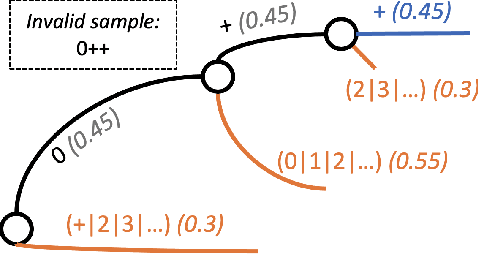
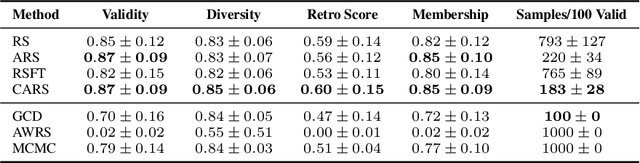
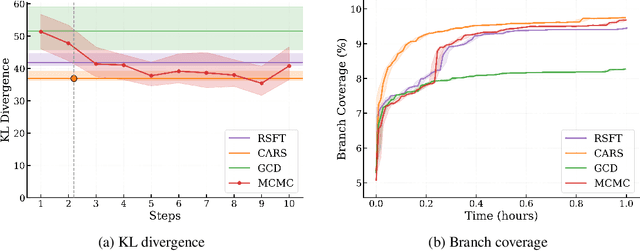
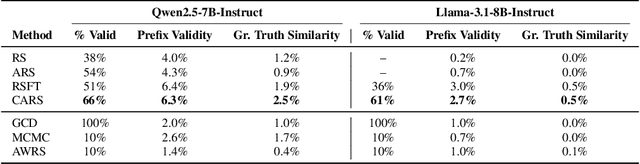
Language Models (LMs) are increasingly used in applications where generated outputs must satisfy strict semantic or syntactic constraints. Existing approaches to constrained generation fall along a spectrum: greedy constrained decoding methods enforce validity during decoding but distort the LM's distribution, while rejection sampling (RS) preserves fidelity but wastes computation by discarding invalid outputs. Both extremes are problematic in domains such as program fuzzing, where both validity and diversity of samples are essential. We present Constrained Adaptive Rejection Sampling (CARS), an approach that strictly improves the sample-efficiency of RS without distributional distortion. CARS begins with unconstrained LM sampling and adaptively rules out constraint-violating continuations by recording them in a trie and subtracting their probability mass from future draws. This adaptive pruning ensures that prefixes proven invalid are never revisited, acceptance rates improve monotonically, and the resulting samples exactly follow the constrained distribution. In experiments on a variety of domains -- e.g., program fuzzing and molecular generation -- CARS consistently achieves higher efficiency -- measured in the number of LM forward passes per valid sample -- while also producing stronger sample diversity than both GCD and methods that approximate the LM's distribution.
Constrained Sampling for Language Models Should Be Easy: An MCMC Perspective
Jun 06, 2025Constrained decoding enables Language Models (LMs) to produce samples that provably satisfy hard constraints. However, existing constrained-decoding approaches often distort the underlying model distribution, a limitation that is especially problematic in applications like program fuzzing, where one wants to generate diverse and valid program inputs for testing purposes. We propose a new constrained sampling framework based on Markov Chain Monte Carlo (MCMC) that simultaneously satisfies three core desiderata: constraint satisfying (every sample satisfies the constraint), monotonically converging (the sampling process converges to the true conditional distribution), and efficient (high-quality samples emerge in few steps). Our method constructs a proposal distribution over valid outputs and applies a Metropolis-Hastings acceptance criterion based on the LM's likelihood, ensuring principled and efficient exploration of the constrained space. Empirically, our sampler outperforms existing methods on both synthetic benchmarks and real-world program fuzzing tasks.
Flexible and Efficient Grammar-Constrained Decoding
Feb 07, 2025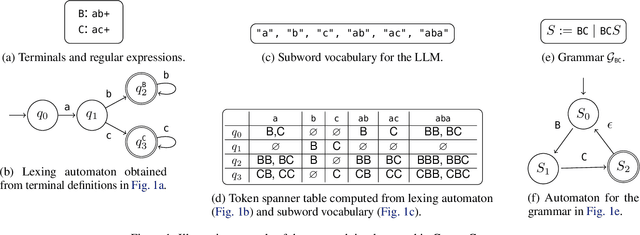
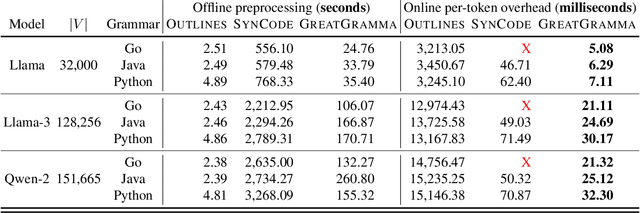
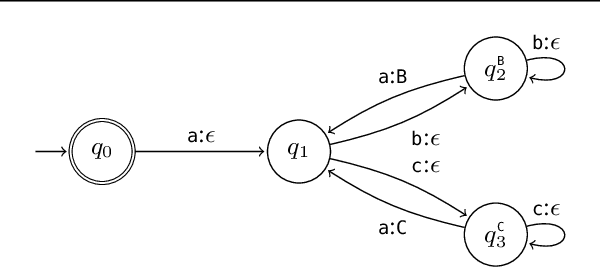
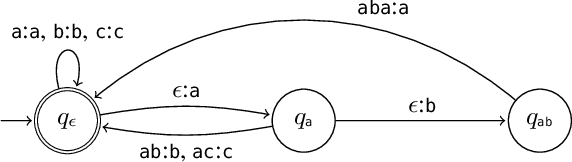
Large Language Models (LLMs) are often asked to generate structured outputs that obey precise syntactic rules, such as code snippets or formatted data. Grammar-constrained decoding (GCD) can guarantee that LLM outputs matches such rules by masking out tokens that will provably lead to outputs that do not belong to a specified context-free grammar (CFG). To guarantee soundness, GCD algorithms have to compute how a given LLM subword tokenizer can align with the tokens used by a given context-free grammar and compute token masks based on this information. Doing so efficiently is challenging and existing GCD algorithms require tens of minutes to preprocess common grammars. We present a new GCD algorithm together with an implementation that offers 17.71x faster offline preprocessing than existing approaches while preserving state-of-the-art efficiency in online mask computation.
Grammar-Aligned Decoding
May 31, 2024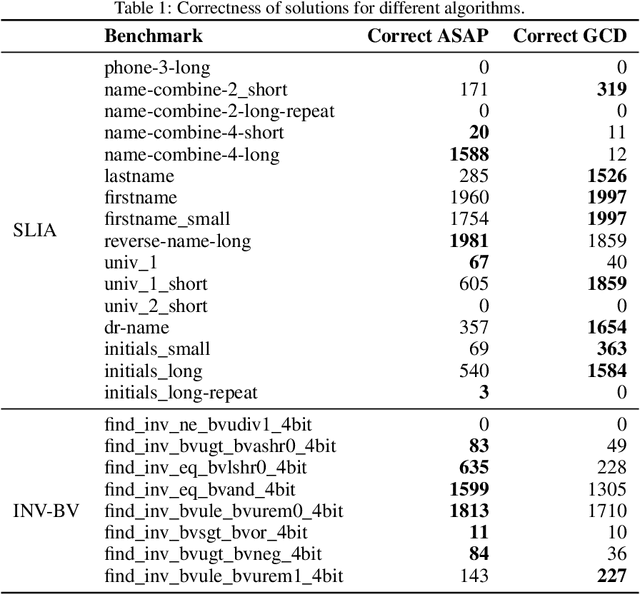
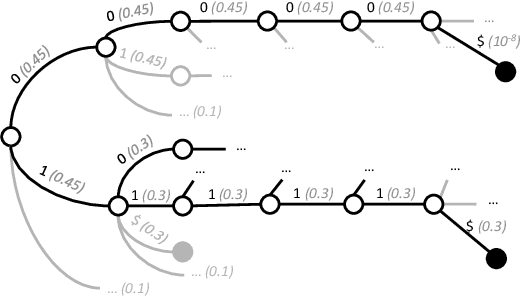

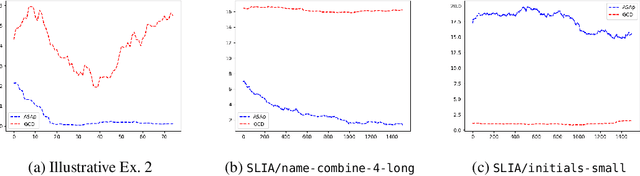
Large Language Models (LLMs) struggle with reliably generating highly structured outputs, such as program code, mathematical formulas, or well-formed markup. Constrained decoding approaches mitigate this problem by greedily restricting what tokens an LLM can output at each step to guarantee that the output matches a given constraint. Specifically, in grammar-constrained decoding (GCD), the LLM's output must follow a given grammar. In this paper we demonstrate that GCD techniques (and in general constrained decoding techniques) can distort the LLM's distribution, leading to outputs that are grammatical but appear with likelihoods that are not proportional to the ones given by the LLM, and so ultimately are low-quality. We call the problem of aligning sampling with a grammar constraint, grammar-aligned decoding (GAD), and propose adaptive sampling with approximate expected futures (ASAp), a decoding algorithm that guarantees the output to be grammatical while provably producing outputs that match the conditional probability of the LLM's distribution conditioned on the given grammar constraint. Our algorithm uses prior sample outputs to soundly overapproximate the future grammaticality of different output prefixes. Our evaluation on code generation and structured NLP tasks shows how ASAp often produces outputs with higher likelihood (according to the LLM's distribution) than existing GCD techniques, while still enforcing the desired grammatical constraints.
A One-Layer Decoder-Only Transformer is a Two-Layer RNN: With an Application to Certified Robustness
May 27, 2024This paper reveals a key insight that a one-layer decoder-only Transformer is equivalent to a two-layer Recurrent Neural Network (RNN). Building on this insight, we propose ARC-Tran, a novel approach for verifying the robustness of decoder-only Transformers against arbitrary perturbation spaces. Compared to ARC-Tran, current robustness verification techniques are limited either to specific and length-preserving perturbations like word substitutions or to recursive models like LSTMs. ARC-Tran addresses these limitations by meticulously managing position encoding to prevent mismatches and by utilizing our key insight to achieve precise and scalable verification. Our evaluation shows that ARC-Tran (1) trains models more robust to arbitrary perturbation spaces than those produced by existing techniques and (2) shows high certification accuracy of the resulting models.